
Mangroves: The Quiet Guardians of Golfo Dulce

When people think of the Golfo Dulce, they often picture rainforest-covered hills, dolphins, whales and calm tropical waters.
But some of the most important ecosystems are found where land and sea meet.
Mangroves are one of them.
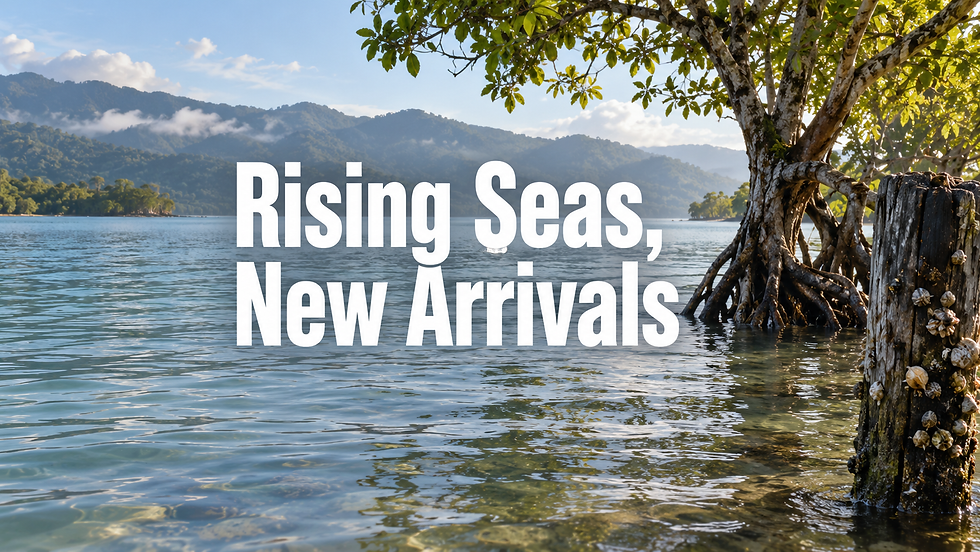
Around the Golfo Dulce, mangrove forests form a living connection between rivers, rainforest and ocean. They provide habitat for wildlife, stabilize coastlines and create sheltered areas used by fish and many other marine species during critical stages of their lives.
Costa Rica’s National System of Conservation Areas recognizes mangroves as an integral part of the wider ecological landscape surrounding the Golfo Dulce. Around Golfito, rivers, streams and mangrove habitats connect directly with the marine ecosystem of the gulf. citeturn632023search0turn632023search3
More than trees standing in water
A healthy mangrove is an extraordinarily complex ecosystem.
Its roots slow moving water and trap sediment. They create sheltered spaces where juvenile fish, crustaceans and other organisms can find food and protection. Birds, reptiles and mammals also depend on these coastal forests.
Research conducted in mangroves at Playa Blanca, Escondido and Rincón de Osa has documented the structural diversity of these forests within the Golfo Dulce region. citeturn632023search10
Mangroves also connect what happens on land with what happens in the ocean.
That matters.
Pollution, sediment, wastewater and changes to watersheds do not simply disappear when they reach the coast. Research in Golfo Dulce mangroves has already shown measurable signs of nutrient enrichment associated with human inputs. citeturn632023search11
Protecting the gulf therefore cannot stop at the shoreline.
A natural climate ally
Mangroves are also increasingly recognized as important blue carbon ecosystems.
They capture carbon through vegetation and store large quantities of it in waterlogged soils. Unlike many terrestrial ecosystems, this carbon can remain stored below ground for very long periods when the ecosystem remains intact.
This makes mangrove conservation relevant not only for biodiversity, but also for climate protection.
Recent scientific work continues to emphasize how important it is to better understand, measure and protect carbon stored in mangrove and other coastal ecosystems. citeturn632023search39
But carbon should not become the only reason to protect them.
A mangrove forest is not simply a carbon account.
It is habitat. A nursery. A coastal buffer. A feeding ground. And part of a much larger ecological system.
Everything is connected
This is one of the central ideas behind #SaveGolfoDulce.
The Golfo Dulce cannot be protected by looking only at whales, only at rainforest or only at water quality.
The system is connected.
Rivers influence mangroves. Mangroves influence coastal waters. Coastal waters support fish, turtles, dolphins and other marine life. Human activities on land can ultimately affect ecosystems kilometres away.
Our long-term work will therefore focus not only on individual species, but on understanding and protecting these connections.
That means supporting research and monitoring, identifying environmental pressures, working with local partners and helping make scientific information accessible to the people whose decisions will shape the future of this region.
Mangroves rarely receive the attention that whales or rainforest wildlife attract.
But protecting the Golfo Dulce without protecting its mangroves would be impossible.
Sometimes the most important ecosystems are also the quietest.


Comments