
Rising Seas, New Arrivals

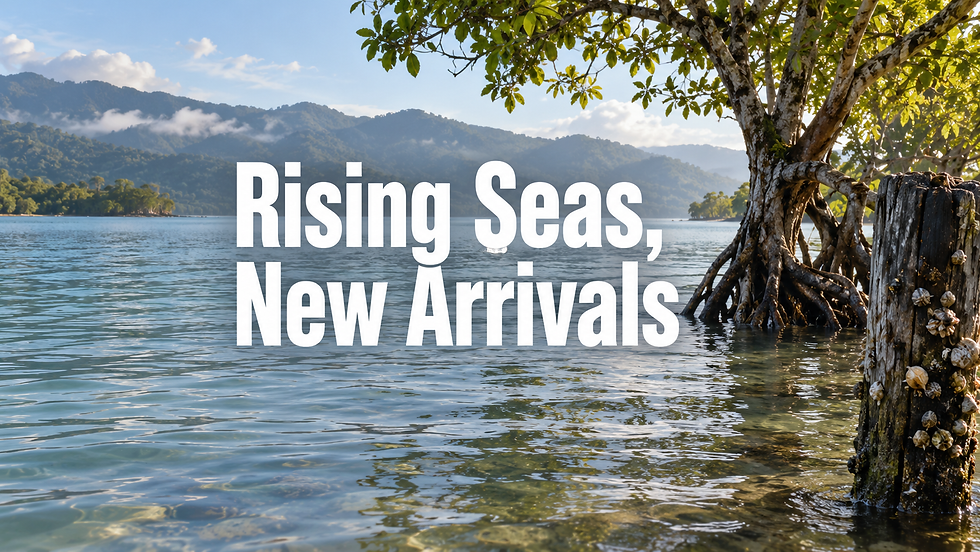
A changing shoreline raises a question beyond where the water will reach: which species could find a home there? New research adds that question to the discussion of coastal adaptation.
What the study projects
Zhang and colleagues modelled habitat suitability for 122 established non-native marine animals. Their projections suggest that roughly 290,000–470,000 square kilometres of newly inundated coastal land could offer suitable conditions by the middle and end of this century. Estuaries at middle latitudes feature prominently.
The analysis focuses on marine ecoregions where each species is already established as non-native. It does not predict all future introductions between regions. Suitable habitat also does not mean that a species has arrived, multiplied or caused ecological harm.
An assumption worth understanding
The supplementary methods connect flooded areas to neighbouring marine habitat: if an adjacent sea cell is suitable for a species, the connected inundated zone is treated as suitable. That is a modelling rule, not a biological survey of the future coastline.
In their published responses to reviewers, the authors acknowledge that water connectivity, sediment behaviour and nutrient conditions could slow or constrain colonisation. They also note that deeper water could remove some existing habitat, partly offsetting gains elsewhere. The headline therefore describes a potential expansion pathway, not a guaranteed invasion.
What this means for Golfo Dulce
This study does not establish a species-level forecast for Golfo Dulce. SaveGolfoDulce would first want local evidence: reliable identifications, dated observations, the location of each record and a clear account of how any projected habitat change was assessed.
A practical response would be to connect coastal planning with a documented biodiversity baseline. Repeated observations could then help distinguish a newly noticed resident from a genuinely new arrival. A photograph can start that inquiry; it should not become an invasion claim without expert identification.
Monitoring proposals should also explain who will maintain records and how findings would guide proportionate action. The useful lesson is to make ecological observation part of adaptation planning, while leaving room for uncertainty and for coastal communities to help define workable priorities.
Sources
Sources checked: 7 October 2026. This account draws on the publisher’s abstract, supplementary methods and published author responses; the subscription-only main text was not independently reviewed. Hero image: AI-generated editorial illustration, not evidence of an invasion or a local sea-level forecast.

Comments