
Safer Seas for Whales

Updated: 3 days ago
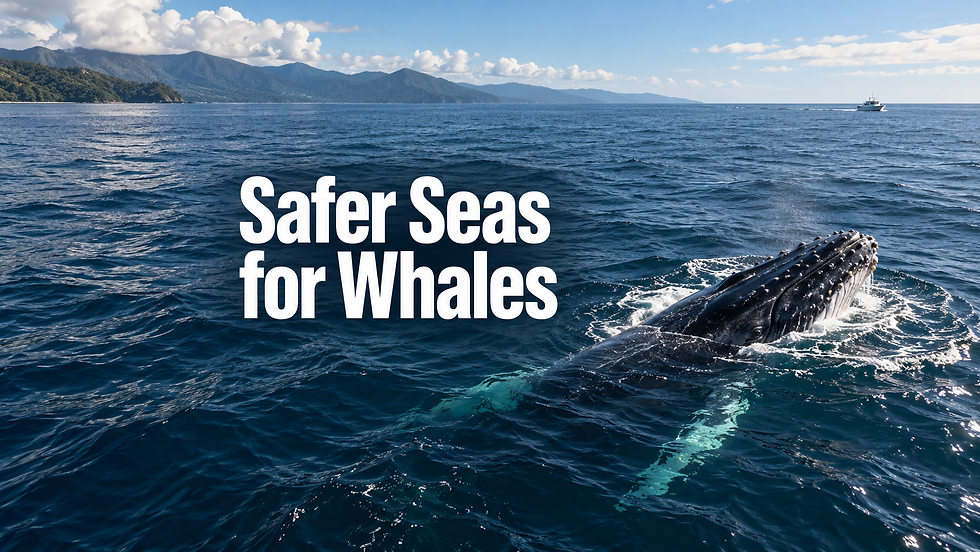
Whale conservation is also a question of how people move through the ocean—and what those journeys sound like beneath the surface.
From an agenda item to an adopted resolution
The International Whaling Commission’s meeting in Hobart concluded on 2 October with a vessel-strike resolution adopted by vote. According to the IWC’s official final-day account, the resolution endorses Scientific Committee guidance on analysing collision risk and encourages collection and sharing of information.
That is a firmer outcome than the earlier meeting agenda alone could establish. The final-day account also recognises work by governments, maritime operators, researchers and civil society. The detailed Chair’s Report was still forthcoming when this article was prepared.
Underwater noise remains a distinct issue
The IWC’s account of the previous day identifies vessel strikes and human-generated ocean noise as recurring subjects at its Science Hub. Governments expressed interest in this work and cooperation with the International Maritime Organization. Noise also had its own Conservation Committee agenda item.
These records support describing both issues as active international priorities. They do not support announcing a separate new noise resolution, a new speed limit for Golfo Dulce or a locally measured level of harm.
What would make the discussion useful locally?
For SaveGolfoDulce, a practical next step would be to connect whale observations with a clearer picture of vessel activity. A future monitoring programme could record observation effort, routes, vessel types, times and conditions, alongside carefully documented acoustic measurements.
The questions should be specific: where and when do animals and traffic overlap? Which observations are reliable enough to guide a response? What information is missing? A seasonal sighting map or a sound recording alone would answer only part of that assessment.
Any proposed local measures should be developed with the responsible authorities, boat operators, fishers and communities. Their likely benefits, practical costs and monitoring requirements should be explained before success is claimed.
Follow implementation as closely as announcements
Our editorial recommendation is to follow what happens after the meeting: published guidance, shared data, responsibilities and subsequent evaluation. International attention is useful when it helps people ask better local questions and build evidence that can be checked.
This article reports international deliberations and offers local monitoring suggestions. It does not assess compliance by any Golfo Dulce operator or announce a change to Costa Rican law.

Comments